
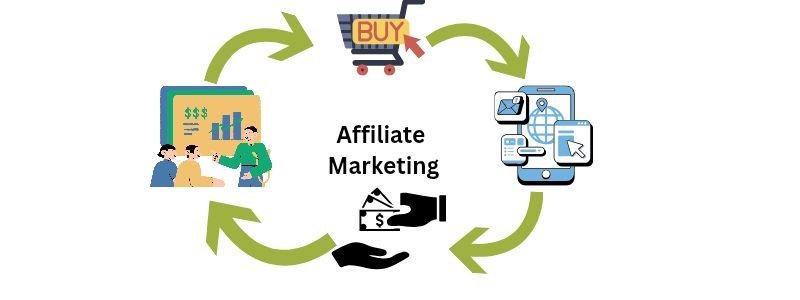
You Are learn What is digital Affiliate marketing the Digital Affiliate Marketing is a business model in which individuals or companies (known as affiliates) partner with a business to promote its products or services online. Commissions are tracked using specific affiliate links or codes. The primary benefit for the business is reaching a wider audience without upfront advertising costs, while affiliates benefit by earning income through recommending products to their audience.
It functions like online ‘word-of-mouth’ advertising supported by tracking technology. For instance, a tech blogger reviewing a new smartphone might include affiliate links to an electronics store. When readers click on these links and make a purchase, the blogger receives a portion of the sale.
Success in affiliate marketing depends on audience trust and the relevance of the offer. Affiliates often publish product reviews, ‘how-to’ guides, or comparison articles and share them via websites, YouTube, podcasts, or social media. Commission rates typically range from 3% to 10% for physical products, whereas digital services like software subscriptions or online courses offer higher payouts. Some affiliates focus on specific niches—such as fitness or finance—while others promote a wide variety of products. The goal is to connect the audience’s needs with effective solutions.
Table of Contents
How does affiliate marketing work.
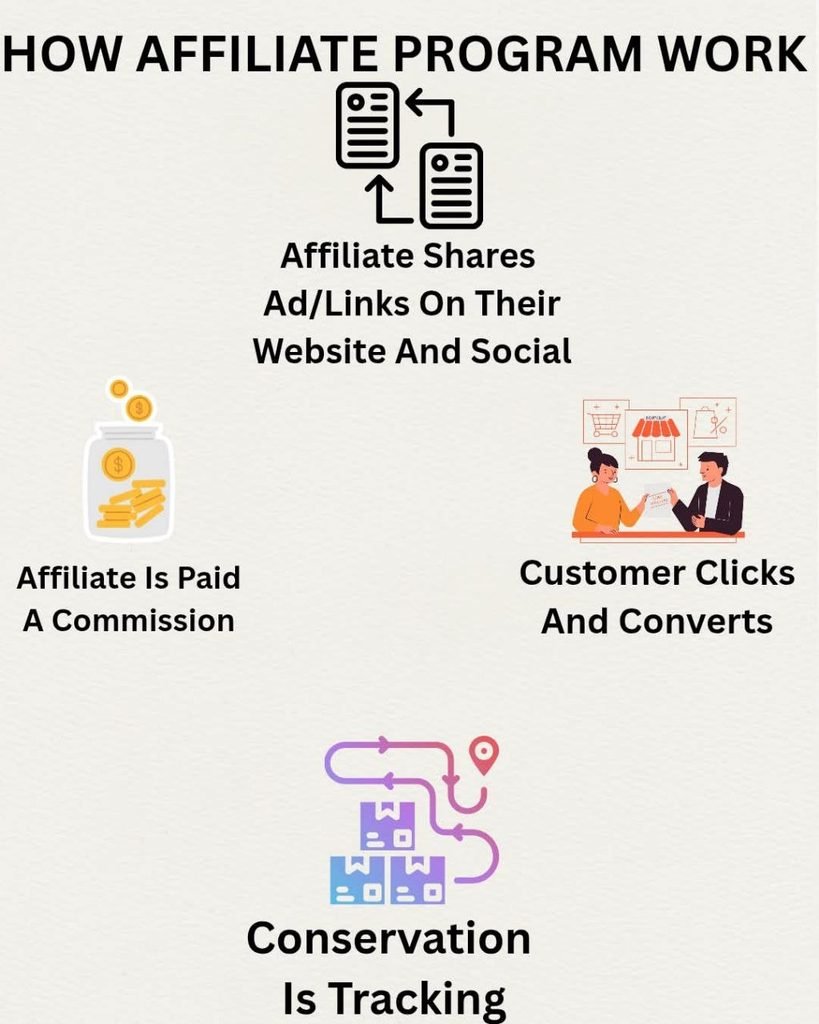
Starting everyone what is Digital Affiliate marketing and how i am start but Affiliate marketing is a performance-based marketing strategy involving three main parties: the merchant (also known as the ‘advertiser’ or ‘retailer’), the affiliate (also known as the ‘publisher’), and the customer. Here is how it works:
1.Advertiser/Merchant:This is the firm or company that provides the product or service to be advertised. To determine which affiliate generated a sale, they provide affiliates with personalized tracking links or affiliate codes.
2.Affiliate:An affiliate is an individual or another company that collaborates with an advertiser. They promote the advertiser’s products and services through various marketing channels, such as websites, blogs, social media, email marketing, and other online platforms.
3.Client:These are the people who visit the advertiser’s website after viewing the affiliate’s promotional content and clicking on their specific tracking link.
4.Turning:A conversion occurs when a user completes a desired action on the advertiser’s website, such as making a purchase, subscribing to a newsletter, or filling out a contact form.
5.Employment:In exchange for referring a transaction, an affiliate receives a commission or a share of the sale. The rates and payment methods can vary and are often agreed upon in advance between the advertiser and the affiliate.
Types of Affiliate Marketing
Affiliate marketing comes in various forms, involving different methods and strategies. While the exact number and classification of these types may vary depending on the source, here are some common ones:
1.Unattached Affiliate Marketing:
An “unattached affiliate” is a type of affiliate marketer who promotes products without having a personal connection, specific expertise, or authority in the product’s field. Unlike related or involved affiliates, unattached affiliates operate purely as advertisers and typically engage in marketing strategies that do not require a personal brand or an established customer base.
What is Unattached Affiliate Marketing?
‘Unattached affiliate marketing’ is a type of affiliate marketing where the affiliate has no specific identity or authority within the product category (niche) they are promoting. Many people prefer this model because it does not require building a reputation or trust with a specific audience. The primary focus here is on driving traffic—often through methods like pay-per-click (PPC) advertising—and increasing sales via the affiliate link.
2.Coupon and Deal Websites
Members of this group focus on providing coupons, discounts, and special offers to their customers. Affiliates receive payment when customers make purchases using these offers. Coupon and deal websites are very common in the e-commerce industry.
3.Email Marketing
Members of this group focus on providing coupons, discounts, and special offers to their customers. Affiliates receive payment when customers make purchases using these offers. Coupon and deal websites are very common in the e-commerce industry.
4.Social Media Affiliate Marketing
Affiliates use social media sites like Facebook, Instagram, and YouTube to promote products and services. They include affiliate links in their descriptions or posts. Influencers often use this method.
Overall, there are various types of affiliate marketing, and each has its own specific strategies and benefits.
The most important thing is to choose a method that best suits your goals and audience, and to build strong relationships with the companies you promote.
5. Comparison and Review Websites.
Affiliates create online resources that provide in-depth analysis and evaluation of various products and services within a specific market. When customers make a purchase by clicking on the affiliate links provided in these product reviews, the affiliate earns a commission.
6. Niche-Specific Affiliate Marketing.
Some affiliates focus on specific markets or sectors, such as technology, finance, or health and wellness. They become experts in their chosen market and provide their audience with information about related products and services.
7. Software and Apps Affiliate Marketing.
In this strategy, mobile or software apps are marketed through affiliate programs. Along with affiliate links, reviews, tutorials, and instructions can also be included for these products.
8. Multi-Tier Affiliate Marketing.
In this method, affiliates can recommend other affiliates and receive payments for referrals from both themselves and the affiliates they have recruited. This results in a multi-tiered commission system.
9. Lead Generation Affiliate Marketing.
The objective of lead generation affiliates is to gather leads or potential customers for the advertiser, rather than focusing on sales. They are paid for bringing in potential customers who typically express interest in a product or service by filling out a form or signing up.
Overall, there are various types of affiliate marketing, and each has its own specific strategies and benefits.
The most important thing is to choose a method that best suits your goals and audience, and to build strong relationships with the companies you promote.
What are the best affiliate programs for beginners.
These are best 9 affiliate marketing programs for beginners. If you have a Website or blog then you will easily get approved by all of them.
- CJ Affiliate:
CJ Affiliate, formerly known as Commission Junction, is a subsidiary of Publicis Groupe, a major player in the affiliate marketing industry. Since its inception in 1998 in Santa Barbara, California, CJ Affiliate has been at the forefront of fostering mutually beneficial relationships between digital marketers and brands. In this review, we will explore how the company stands as a prime example of global reach and innovation; beyond the United States, it operates offices in the UK, Germany, France, Spain, Sweden, Poland, the Czech Republic, and India. If you are considering partnering with CJ Affiliate, this review will provide you with valuable information.
This affiliate network operates on a massive scale and features an affiliate marketplace that connects affiliate partners with over 20,500 merchants—ranging from rapidly growing startups to the world’s most renowned brands. As a prominent name in the affiliate marketing industry, CJ Affiliate offers a robust ecosystem. Here, affiliate marketers can earn commissions by promoting advertisers’ products or services and utilize a wide range of tools and resources designed to help them succeed. Compared to other affiliate networks, CJ Affiliate stands out due to its extensive reach and diverse range of opportunities.
- ShareASale: If you are new to this field, ShareASale is an affiliate marketing platform that connects you with brands willing to pay for results. This network includes over 30,000 merchants across sectors like fashion, finance, tech, and various unique niches. (Yes, there is an affiliate program for almost everything—perhaps even for cat hammocks.)
This system is primarily based on ‘Pay-Per-Sale’ (PPS), meaning you earn money only when your audience actually makes a purchase. This implies that random clicks won’t suffice; you will need content, sales funnels, and a bit of patience.
So, what is the ShareASale affiliate program actually like? It is largely ‘plug-and-play’: you join, browse the merchants, apply, and start creating affiliate links.
- Click Bank:
ClickBank is an e-commerce platform and affiliate marketplace.
Simply put, think of ClickBank as a link or intermediary connecting customers, product owners, and affiliate marketers—we bring all parties together and provide the necessary infrastructure for seamless online transactions.
- JVZoo: JVZoo is an affiliate marketing platform that allows affiliates to discover and sign up for multiple affiliate programs in one place, eliminating the need to visit separate sites for each program. It also helps you track your earnings and assets, keeping everything organized and easily accessible.
- Amazon Associates:
Welcome to one of the world’s largest affiliate marketing programs. The Amazon Associates Program helps content creators, publishers, and bloggers monetize their traffic. With millions of products and programs available on Amazon, associates use easy link-building tools to share recommendations with their audience and earn money from qualifying purchases and programs. - SendInBlue: Sendinblue is a comprehensive, cloud-hosted digital marketing SaaS toolkit. It is specifically designed to enable businesses to promote their products and services across various platforms, including email, SMS, chatbots, and WhatsApp. The software also includes tools for audience analysis and data capture to support end-to-end digital marketing campaigns.
- Aweber:
AWeber is an email marketing and automation tool designed for creators and small businesses looking for a hassle-free solution. Launched in 1998, it is the second-oldest tool of its kind, following Constant Contact, which debuted in 1995.
Over time, it has enhanced its newsletter capabilities by introducing features such as autoresponder sequences, landing pages for list building, and email automation.
On paper, features like email lists and generous email sending quotas (both are unlimited with the Plus plan) look very attractive. In reality, however, the cost is determined by the number of subscribers, and at certain tiers, the plans end up being more expensive than those of specialized tools like Omnisend.
For this reason, AWeber is a more suitable choice for creators, bloggers, sellers of info-products, service-based businesses, and small (eBay-style) gigs, rather than for complex e-commerce stores.
- Appsumo:
AppSumo was launched in 2011 by serial entrepreneur Noah Kagan (who is also behind software tools like Sumo and KingSumo). David Garland explains how Kagan built this business over a single weekend for just $50—and how it grew into a million-dollar business in less than two years.
Kagan has collaborated with well-known figures like Neville Medhora. Medhora helped grow AppSumo’s email list from zero subscribers to 700,000. The sales page for ‘Prey’ was Medhora’s first sales page and email campaign—it was so successful that he went on to write all the sales pages for the next two years.
AppSumo has become a growth-hacking engine for many businesses running lifetime deals on its marketplace. Thanks to AppSumo, NinjaOutreach acquired 2,500 new users, and PixelMe generated $166,721 in revenue. To date, AppSumo has generated millions for its partner companies and saved billions for its customers. What did you think of this AppSumo review? I asked Noah Kagan on Twitter about AppSumo’s very first deal, and I was delighted when he replied:
- Canva: Canva is a versatile graphic design tool suitable for students, professional designers, online content creators, and anyone who wants to create and share images and videos with friends and family. Launched in 2012, Canva serves over 175 million monthly users worldwide.
From traditional graphic design to content created using social media and Artificial Intelligence (AI), you can use Canva to create:
Personal and business documents
Whiteboards
Presentations
Social media posts
Image and video editing
Print products, such as T-shirts, posters, mugs…
Websites
Brochures
Newsletters
E-books
Labels
Infographics
And that’s just the beginning! Whatever you need to design, you’ll likely find a feature or plugin app in Canva to help you get the job done!
Hope this helped you.
How do I start affiliate digital marketing.
Step 1: Create a website or blog.
Step 2: Choose an industry, and then select a specific topic (niche).
Step 3: Find products within your chosen niche that you can review.
Step 4: Sign up for the Amazon affiliate program.
Step 5: Find affiliate programs for other products you wish to review.
Step 6: Create content—such as tutorials, review posts, resource pages, or emails—and include your affiliate links.
Step 7: Optimize the page and track your ranking on Google.
Step 8: Keep repeating this process!
I had initially planned to explain the entire process in this post, but honestly, it is quite straightforward, and you likely already know many of these things.
So, instead of doing that, I want to focus on what makes a good affiliate product and how to promote it successfully.
If you want comprehensive information on building an affiliate blog or niche site and making money from it, be sure to check this out.
Do affiliates really make money.
Affiliate marketing is the most profitable way to earn money online.
It is a method of earning a commission by promoting other people’s products.
You choose a product you like, promote it to others, and earn a share of the profit on every sale.
And yes, in India as well as any more country you can earn up to $1,000 per month through affiliate marketing.
However, it is not that easy, as many people fail to earn that much.
There is no limit to how much money you can earn from an affiliate program.
It all depends on the program you are promoting and the number of conversions (sales) you generate daily.
The good news is that there is also the potential to earn more than $1,000 per month.
You simply need to work with the right strategies and a proper plan.
How to earn affiliate income?
Affiliate marketing is a form of self-employment that requires low initial investment and does not involve manufacturing, stocking, or shipping products. It is a logical and flexible sales model that creates multiple revenue streams. However, it is not a scheme for easy money or getting rich quick. Earning through affiliate marketing requires the following:
- Researching products, web traffic patterns, and the preferences of your followers.
- Staying consistently engaged with the products and brand networks you choose to promote.
- Spending hours building relationships with the readers or followers who purchase products through your affiliate links.
- Understanding and utilizing search engine optimization (SEO) and social media marketing to continuously attract new followers and generate additional income. Affiliate earnings are not always consistent.
You should view your earnings on an annual basis rather than a monthly one. A successful affiliate marketer can earn anywhere from $10,000 to $400,000 per year.
Can I do faceless affiliate marketing.
Yes, you can earn money from affiliate marketing without showing your face. There are several ways to promote affiliate products without using your personal image, such as:
Writing blog posts or articles reviewing the product
Creating YouTube videos without showing your face (e.g., using screen captures or animations)
Using social media platforms without revealing your identity (e.g., using a logo or a pseudonym)
Creating email marketing campaigns
Building a website that focuses on the product and its benefits.
Trust me!
This Blog enough for your affiliate marketing journey. but if at that now you have any dought for whai is digital affiliate Marketing so learn this blog.
Can i affiliate without any followers.
Affiliate marketing is a skill-based business, not a shortcut. You can start—and succeed—in it even without an existing following.
Starting out without prior experience or a degree doesn’t guarantee immediate income, but it fosters a ‘growth mindset.’ You learn to focus, acquire knowledge, and hone your skills, all of which propel you to the next level.
How does affiliate marketing work without a large following.
Focus on a specific niche: Choose a topic you understand well or are willing to learn about. It could be anything from personal finance and healthcare to skincare.
Create useful content: Even a single helpful post can attract people looking for solutions to problems or answers to their questions. You don’t need millions of views; instead, you need valuable content that connects your audience to you.
Use search-based platforms: On platforms like Quora, YouTube Search, and Facebook Groups, your content can reach people who are actively seeking answers.
Earn your audience’s trust before selling anything: People don’t buy just because you shared a link; they buy because they trust your advice. Trust is your real asset, so focus on helping people first.
Be consistent: For successful affiliate marketing, it is essential to publish useful content regularly and consistently. Every answer, video, or post can create another opportunity for a new person to discover you.
If you want learn how to write a blog so click on it.
and also you learn for ecommerce business so click on blog.
Conclusion For Digital Affiliate Marketing:
Ultimately, affiliate marketing is a smart way for companies and individuals to collaborate and foster mutual growth. It is a partnership that benefits both parties: companies gain more customers, while individuals or websites earn money by promoting products. As the online landscape evolves, affiliate marketing will also change, yet its core principle of rewarding hard work and quality will remain constant, ensuring it continues to be an excellent strategy for the digital age.
4 thoughts on “what is digital affiliate marketing?”