

In this guide, we’ll show you how to sell digital products online, from choosing an idea to finding your first customers.
Selling something online does not always mean keeping boxes at home, managing stock, or worrying about delivery. Today, you can create a useful digital product once and sell it to customers through the internet without dealing with physical inventory.
An e-book, online course, design template, music track, software tool, printable planner, or premium resource can all be turned into a digital product business.
The interesting part is that you don’t necessarily need a large team or a huge budget to get started. What matters more is finding a real problem, creating something that solves it, and putting it in front of the right people.
In this guide, we’ll look at how to sell digital products online, what you can sell, how to create your first product, where you can sell it, and how to find your first customers.
Table of Contents
How to Sell Digital Products Online From India
A digital product is a product that is created, delivered, and used electronically rather than as a physical item.
For example, if someone buys a PDF guide and downloads it to their phone, that PDF is a digital product. The same idea applies to an online course, Canva template, stock photo collection, music file, software application, or digital planner.
Unlike a physical product, you don’t need a warehouse or shipping company to deliver most digital products. After a customer completes a purchase, the product can usually be delivered through a download link, email, account, or membership area.
That makes digital products an interesting option for creators, freelancers, educators, designers, and small online businesses.
Types of Digital Products You Can Sell
There isn’t one fixed type of digital product that everyone should sell. The right product depends on your knowledge, skills, audience, and the problem you want to solve.
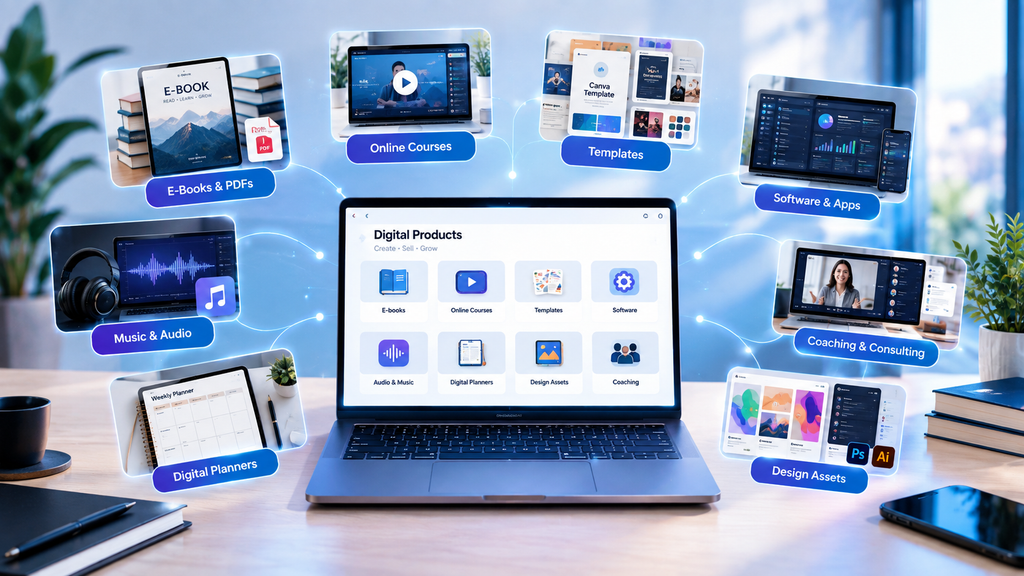
Here are some popular options.
1. E-books and Digital Guides
E-books are one of the simplest digital products to create.
You could write a practical guide about a subject you understand, such as:
- Digital marketing
- Personal productivity
- Photography
- Fitness
- Freelancing
- Video editing
- Online business
- Study techniques
A useful e-book doesn’t have to be hundreds of pages long. A short guide that solves one specific problem can be more useful than a huge book filled with general information.
2. Online Courses
If you know how to do something and can explain it clearly, you can turn that knowledge into an online course.
For example, a video editor could create a beginner editing course, while a digital marketer could create a course explaining SEO basics.
Courses can include:
- Video lessons
- Worksheets
- Assignments
- Checklists
- Downloadable resources
- Bonus materials
The key is to teach a clear outcome instead of simply putting a collection of information behind a payment wall.
3. Templates and Digital Downloads
Templates can save people time, which makes them useful digital products.
Examples include:
- Social media templates
- Resume templates
- Presentation templates
- Budget spreadsheets
- Content calendars
- Notion templates
- Business documents
- Study planners
Instead of creating everything from scratch, customers can purchase the template and customize it for their own needs.
4. Design Assets
Designers can sell ready-made creative resources such as:
- Icons
- Illustrations
- Presentation graphics
- Mockups
- Backgrounds
- Social media designs
- Website assets
A niche-specific collection can be more useful than a random collection of graphics because customers know exactly what they are getting.
For example, a designer could create a collection specifically for real-estate businesses rather than simply selling “100 random social media graphics.”
5. Music and Audio Products
Musicians and audio creators can also build digital products.
Some possibilities include:
- Beats
- Sound effects
- Loops
- Sample packs
- Presets
- Podcast intros
- Background music
- Audio production resources
The important thing is to make sure you own the rights to the material you’re selling or have the appropriate licenses.
6. Software and Apps
Software can become a digital product when it solves a specific problem.
This could be a small productivity tool, calculator, editing utility, business application, browser extension, or subscription-based service.
Software usually requires more development and customer support than a simple PDF or template, but it can also provide a more specialized solution.
7. Coaching and Consulting
Not every digital product has to be a downloadable file.
If you have valuable expertise, you can sell your knowledge through online coaching or consulting.
For example:
- SEO consulting
- Website audits
- Marketing strategy sessions
- Career guidance
- Content strategy
- Business consultations
Coaching focuses more on helping an individual work toward a specific goal, while consulting generally involves providing expert recommendations for a particular business or problem.
Why Sell Digital Products Online?
Digital products have a few characteristics that make them attractive to online creators.
Low Physical Overhead
There is no need to manufacture a new physical item for every customer. You don’t have to store boxes of inventory or arrange traditional shipping.
Once the product is ready, delivering another copy is generally much simpler.
Easy to Scale
Imagine you create a useful $10 guide.
Whether ten people purchase it or one hundred people purchase it, you don’t have to manually manufacture another physical copy for every buyer.
Of course, scaling a digital product business still requires marketing, customer support, updates, and improvements. It isn’t automatically passive income.
Sell Beyond Your Local Area
The internet allows a creator to reach customers outside their own city or country.
A designer in India can potentially sell a template to a customer in another country. A course creator can teach students from different locations. A software developer can build a tool for an international audience.
Your location doesn’t necessarily have to limit your potential market.
Where Can You Sell Digital Products Online?
This is where many beginners make their first mistake.
They start by asking:
“What digital product should I create?”
A better question is:
“What problem can I solve for a specific group of people?”
For example, instead of creating a generic “Social Media Guide,” you could create:
“30-Day Instagram Content Planner for Local Businesses.”
The second idea has a clearer audience and purpose.
Before creating anything, ask yourself:
- Who is going to use this product?
- What problem does it solve?
- Why would someone pay for it?
- Can I create it to a useful standard?
- Where can I find people who need it?
If you can’t answer these questions, spend more time researching before starting production.
How to Create Your First Digital Product
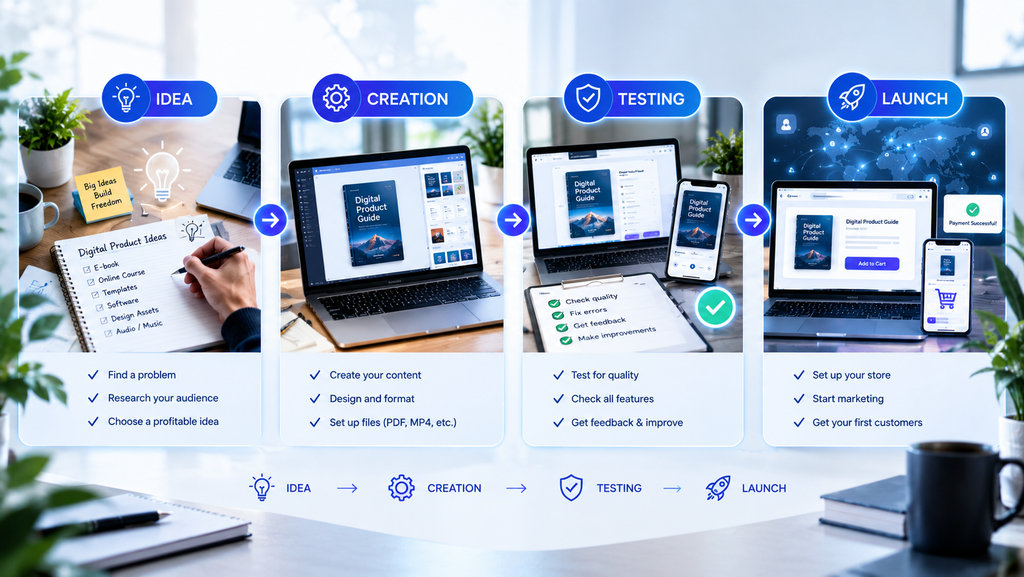
You don’t need to build a complicated product for your first attempt.
Start small.
Step 1: Choose One Specific Problem
Pick one problem that your target audience regularly faces.
For example:
A beginner wants to start Instagram marketing but doesn’t know what to post.
Your product could be a 30-day Instagram content calendar.
Step 2: Research the Audience
Look at questions people ask in communities, comments, forums, social media, and search engines.
Pay attention to repeated problems.
The goal isn’t to copy someone’s product. It’s to understand what people actually need.
Step 3: Create the Product
Now build the solution.
Depending on the product, you might use:
- Canva
- Google Docs
- Spreadsheet software
- Video editing software
- Design tools
- Website builders
- Development tools
AI tools can also help with brainstorming, organization, research assistance, or first drafts, but the final product should be checked, improved, and made genuinely useful by you.
Step 4: Test It
Before launching, give the product to a few people who match your target audience.
Ask them:
- Was it easy to understand?
- Was anything missing?
- Was it useful?
- What would you change?
- Would you pay for something like this?
Their feedback can reveal problems you may not notice yourself.
How to Price Your Digital Product
There isn’t one perfect price for every digital product.
A $5 template and a $500 consulting package obviously shouldn’t be priced the same way.
Think about:
- The problem being solved
- The time saved
- The quality of the product
- The target customer
- Competing products
- Your experience
- The amount of support included
If you’re launching your first product, you can start with a simple price and adjust it after receiving real customer feedback.
Don’t automatically make your product extremely cheap just because you’re new.
If it solves an expensive or time-consuming problem, its value may be much higher than the amount of time you spent creating it.
Where Can You Sell Digital Products Online?
You have several options.
Digital Product Marketplaces
Platforms such as Gumroad and similar digital-commerce services can make it easier to start selling without building a complete store from scratch.
They’re useful when you want to test an idea quickly.
Your Own Website
Selling through your own website gives you more control over your branding and customer experience.
For example, you could create a dedicated product page containing:
- Product description
- Benefits
- Preview images
- Customer questions
- Pricing
- Purchase button
- Refund information
Your website can also become the long-term home for your content and products.
Social Media
Social media can be used to bring attention to your product.
For example, if you sell an Instagram content planner, you could publish free content about Instagram marketing and then direct interested readers toward your paid product.
The goal isn’t to constantly tell people to buy.
Instead, give useful information first and introduce the product when it naturally fits the problem you’re discussing.
How to Sell Digital Products From India
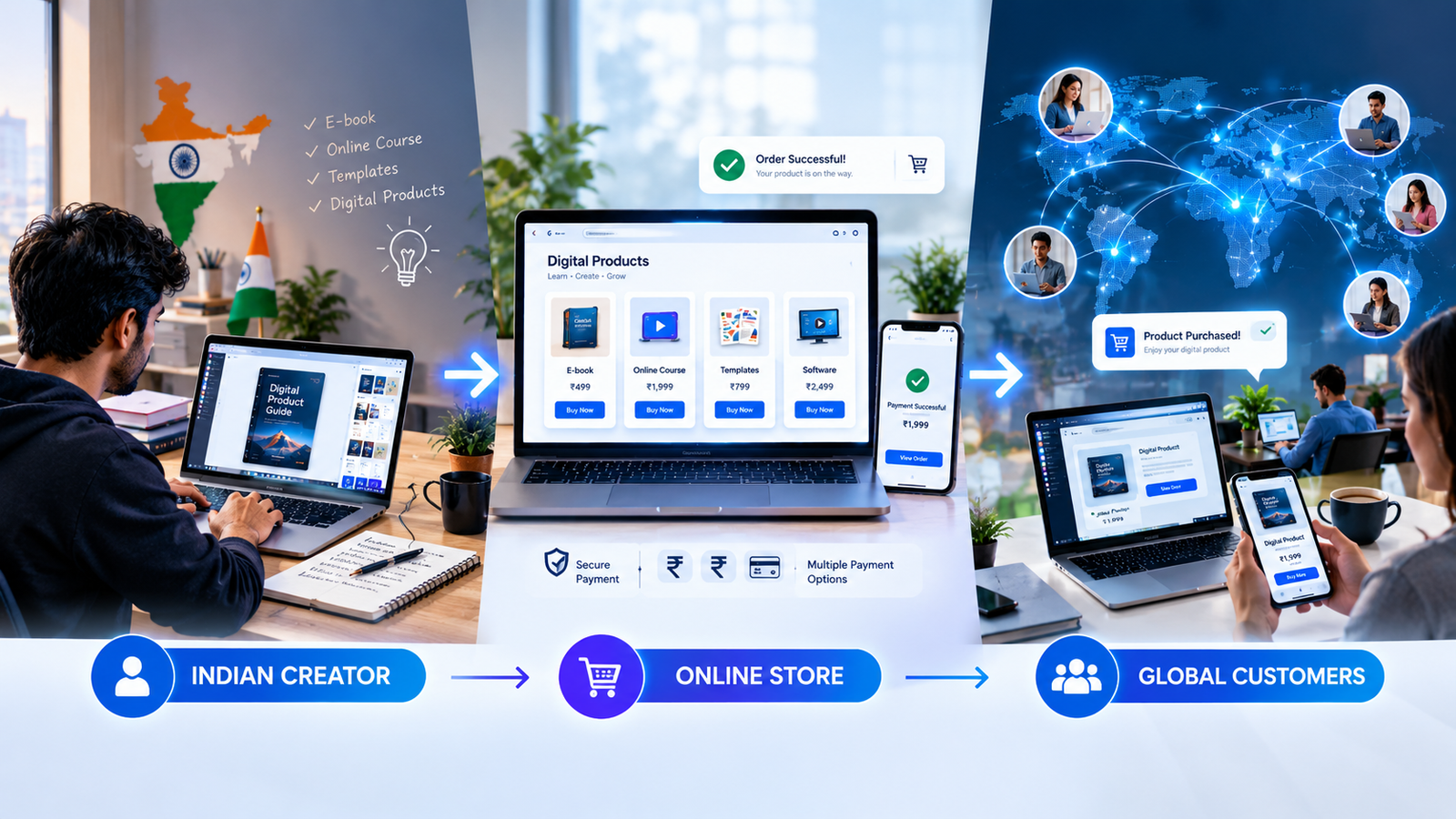
If you’re based in India, you can build a digital-product business for both Indian and international customers.
Before launching, check:
- Which payment methods your platform supports
- Whether customers can pay internationally
- Platform transaction fees
- Currency conversion charges
- Applicable tax requirements
- Refund policies
- Digital delivery options
For an Indian audience, pricing in rupees can make the buying decision simpler.
For international customers, you may choose to display prices in another currency if your payment platform supports it.
For tax and compliance matters, check the current rules applicable to your specific business rather than relying on a generic online article.
How to Market Your Digital Product

Creating the product is only half the job.
People need to discover it.
Content Marketing
Create useful content around the problem your product solves.
For example, if you sell an SEO checklist, publish articles and videos about beginner SEO mistakes, keyword research, on-page SEO, and website optimization.
Some readers may eventually become customers.
YouTube
You can demonstrate your knowledge through tutorials, case studies, walkthroughs, and practical videos.
A video can also show people exactly what your product helps them accomplish.
Instagram and Short-Form Content
Short videos can be useful for reaching people who don’t know your brand yet.
Instead of making every video an advertisement, share quick tips, mistakes, examples, and mini tutorials.
Email Marketing
If people willingly subscribe to your email list, you can continue providing useful information and occasionally introduce relevant products.
A free checklist, mini-guide, or sample can be used as an incentive for people to join your list.
How to Get Your First Digital Product Customer
Your first sale can be harder than your hundredth because nobody knows your product yet.
Start with the people most likely to have the problem you’re solving.
You can:
- Share useful educational content
- Demonstrate the product
- Give away a small sample
- Ask existing followers for feedback
- Build an email list
- Collaborate with relevant creators
- Publish tutorials around the product
- Improve your product page based on questions people ask
Don’t focus only on getting traffic.
Focus on getting the right traffic.
One hundred people who actually need your solution can be more valuable than thousands of random visitors.
Common Mistakes to Avoid
Creating a Product Nobody Needs
A beautiful product won’t sell if it doesn’t solve a real problem.
Trying to Target Everyone
A product made for everyone often feels relevant to nobody.
Start with a specific audience.
Copying Existing Products
Research is useful, but copying another creator’s product, wording, design, or unique material isn’t a sustainable strategy.
Study the market, then create your own solution.
Depending Completely on AI
AI can speed up parts of the creation process, but simply generating hundreds of generic products and uploading them everywhere isn’t a substitute for expertise or usefulness.
Your experience, editing, testing, examples, and original perspective are what can make a digital product different.
Expecting Instant Passive Income
A digital product can be delivered automatically, but the business behind it still needs work.
You may need to:
- Update the product
- Answer customer questions
- Fix problems
- Create content
- Improve your sales page
- Study customer feedback
- Promote the product
Think of automation as reducing repetitive work, not eliminating work completely.
A Simple Digital Product Business Model
If you’re starting from zero, keep the process simple:
Find a problem → Research the audience → Create a small solution → Test it → Launch → Promote → Collect feedback → Improve → Repeat
For example:
Problem: Small businesses don’t know what to post on Instagram.
Product: 30-day social media content calendar.
Free content: Instagram post ideas and common mistakes.
Paid product: Complete content calendar with captions, hooks, and templates.
Marketing: Instagram Reels + YouTube Shorts + blog content.
This model is much easier to understand than trying to launch ten different products at once.
For Business and learning affiliate marketing so click on it.
As well as if you learn about blog then click on it.
Frequently Asked Questions
Is it difficult to learn how to sell digital products online?
It can be, but profitability depends on the product, audience, pricing, marketing, competition, and operating costs. Creating a digital file doesn’t automatically guarantee sales.
What is the easiest digital product to create?
For many beginners, simple products such as checklists, templates, spreadsheets, short guides, and planners can be easier to create than software or large online courses.
Can I sell digital products without a website?
Yes. You can start through platforms that support digital product sales. However, having your own website can give you more control over your brand and long-term audience.
Can I use AI to create digital products?
AI can assist with research, brainstorming, organization, design ideas, and other parts of production. However, you should review the output carefully and add your own expertise, examples, editing, and value.
Can I sell digital products internationally?
Potentially, yes. Your ability to sell internationally depends on your platform, payment provider, product type, applicable laws, and other business requirements.
Final Thoughts
Selling digital products online isn’t about finding a magic product that makes money overnight.
The stronger approach is much simpler: find a specific audience, understand a problem they have, create a useful solution, and learn how to put that solution in front of the right people.
You could start with something as simple as an e-book or template and gradually move toward courses, memberships, consulting, software, or other products as your skills and audience grow.
The first product doesn’t have to be perfect.
It needs to be useful.
Once you have real customers and real feedback, you’ll have something much more valuable than assumptions—you’ll have information you can use to improve the next version.
I hope this blog help to your knowledge and also how to sell a digital product.
That’s where a small digital product can turn into a real online business.
1 thought on “How to Sell Digital Products Online: A Practical Beginner’s Guide”