
Have you ever opened an app or website and noticed an advertisement that looked related to something you were interested in? Those ads can sometimes be delivered through an advertising network.
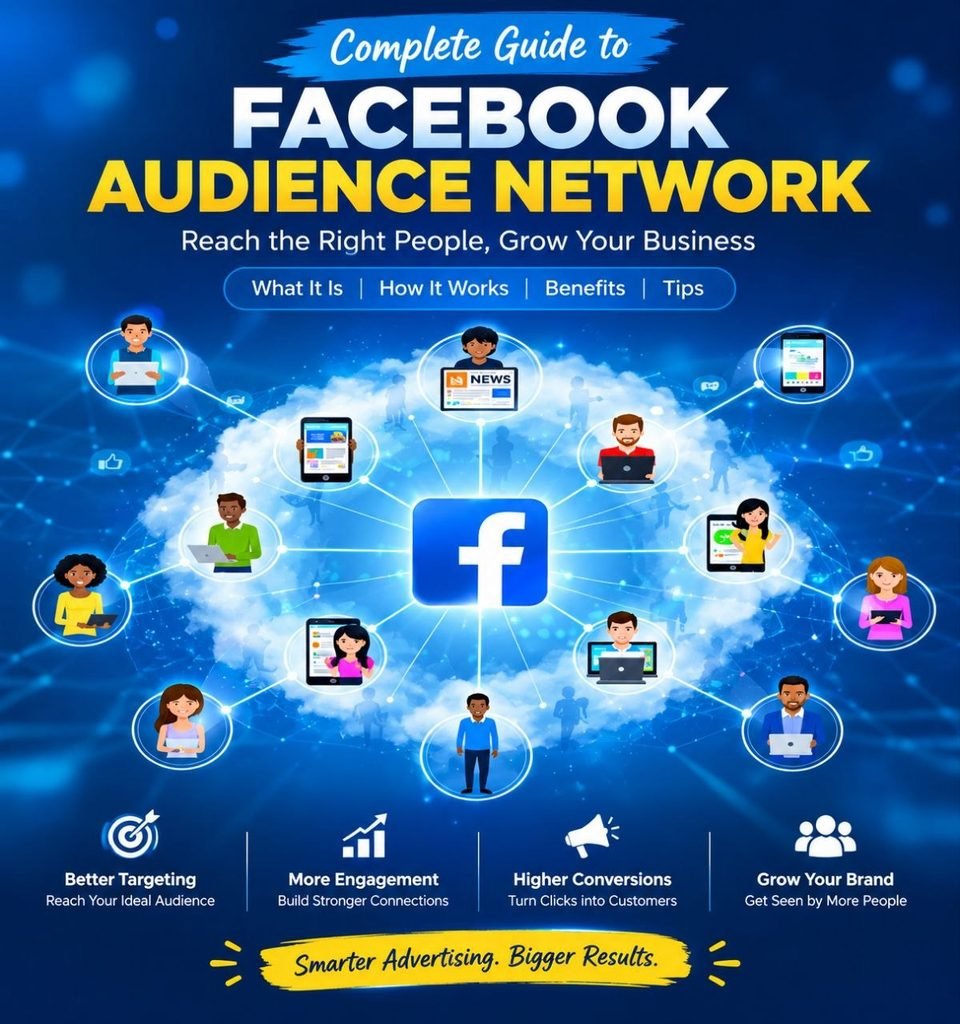
The Facebook Audience Network is one such network. It allows businesses to show their advertisements not only on Facebook but also on participating third-party apps and websites.
If you are new to Facebook advertising, the name can sound a little confusing. So, in this guide, we will explain what Facebook Audience Network means, how Facebook ads work, what affects ad costs, the different ad formats, and how Facebook creators can earn from views.
Table of Contents
What Is Facebook Audience Network?
Facebook Audience Network is a collection of third-party apps and websites where advertisements from Meta’s advertising system can be displayed.
The basic idea is simple. Instead of showing an advertisement only to people using Facebook, advertisers can reach users in other places where Audience Network ads are available.
The ads can be selected according to different user and campaign signals, including interests and browsing behavior.
For advertisers, this can provide additional reach. For participating publishers and creators, advertising can become another possible source of income.
What Is Facebook Advertising?
Facebook advertising, now generally known as Meta advertising, is a paid advertising system that businesses can use to promote their products, services, apps, or brands.
When creating a campaign, an advertiser can choose what they want to achieve, select an audience, set a budget, choose advertising formats and placements, and then monitor the results.
For example, one business might want more people to know about its brand, while another might be interested in getting leads or sales.
The campaign objective is important because Meta uses it to help deliver advertisements toward people who are more likely to take the desired action.
How Do Facebook Ads Work?
Facebook ads start with a goal.
Before running an advertisement, a business normally decides what it wants from the campaign. It could be awareness, engagement, website traffic, leads, sales, or app installs.
After choosing the objective, the advertiser can define the audience and decide how much money to spend.
Meta then uses the campaign information to deliver the advertisement to people who are more likely to match the selected goal.
This is why getting millions of impressions does not automatically mean an ad campaign is successful. The people seeing the ad should also be relevant to the business.
Types of Ads You Can Run
Meta provides several formats that businesses can use for their advertising campaigns.
Some of the available formats include:
- Photo ads
- Video ads
- Carousel ads
- Slideshow ads
- Store ads
- Marketplace ads
- Messenger ads
- Collection ads
- Playable ads
Each format has its own purpose.
For example, a carousel can be useful when a business wants to show several products in one advertisement. A video can be more useful when a company wants to demonstrate a product or explain a service.
The format you choose can also affect where your advertisement appears.
How Much Does Facebook Advertising Cost?
There is no fixed price for Facebook advertising.
The amount you pay can change from one campaign to another. Several things can affect the cost, including your campaign objective, audience, ad creative, location, time of year, and placement.
This means that two businesses spending the same amount may not get the same number of impressions, clicks, leads, or sales.
Let’s look at the main factors.
1. Campaign Objective
Your campaign objective can have a direct effect on advertising costs.
Meta provides objectives such as:
- Awareness
- Engagement
- Traffic
- Leads
- Sales
- App installs
Different objectives are aimed at different types of user actions.
For example, an engagement campaign may look for people who are likely to interact with an advertisement. A lead campaign is focused more on people who may be willing to provide their information.
Because these audiences can behave differently, their advertising costs can also be different.
One commonly used measurement is CPM, which means the cost per 1,000 impressions.
2. Audience Targeting
The audience you select can also change your advertising cost.
A broad audience may sometimes be cheaper because there are more people available to reach. A very specific audience can cost more because fewer people match the targeting conditions.
For example, targeting people interested in food and beverages can have different competition from targeting people interested in buying expensive products such as chandeliers.
So, audience size is not the only thing that matters. Audience quality and competition also play a role.
3. Quality of Your Ad Creative
The advertisement itself matters too.
A clear image, useful message, and attractive creative can encourage people to stop scrolling and interact with the ad.
If people respond positively to an advertisement, those engagement signals can help the system understand that the creative is relevant to its audience.
That is why simply increasing your budget is not always the answer. Sometimes improving the advertisement itself can make a noticeable difference.
4. Location
Where you advertise can affect the cost.
Some locations have more advertisers competing for the same audience. Tier-1 cities, for example, can have strong competition because many businesses want to reach users there.
When competition increases, the price of available advertising space can also increase.
In some cases, advertising in smaller cities may have lower competition and therefore lower CPM.
However, there is no single rule that applies to every campaign.
5. Festivals and Special Occasions
Advertising costs can change during festivals, holidays, weekends, and other popular shopping periods.
Why?
Because more businesses often start advertising during these periods. More advertisers competing for the same audience can push up the cost.
So, an advertising budget that performs well during a normal week may not produce exactly the same results during a major festival.
6. Ad Placement
The location where your advertisement appears also matters.
Meta provides multiple placements, including areas such as Facebook feeds, Stories, Reels, Messenger, and other available locations.
Some placements can have more competition than others. As a result, the CPM can change depending on where the advertisement is being shown.
Facebook Advertising Budget Options
Meta gives advertisers different ways to control their spending.
The two basic options discussed here are Daily Budget and Lifetime Budget.
Daily Budget
A daily budget is the amount you plan to spend on your campaign each day.
For example, if you set a daily budget of $10, your campaign is planned around that daily amount.
You can increase or decrease the budget later depending on your campaign performance and requirements.
Lifetime Budget
A lifetime budget is the total amount you want to spend during the entire campaign.
Instead of setting a fixed amount for every day, you give Meta a total budget for the campaign period.
Daily spending can vary, but the overall campaign spending is managed around the lifetime budget.
How Much Does Facebook Pay for 1,000 Views?
There is no fixed amount that Facebook pays for every 1,000 views.
Creator earnings can depend on several things, including:
- Where the audience is located
- Type of content
- Engagement
- Advertising demand
- Ad format
- Monetization eligibility
The source information for this article mentions figures such as around $8.75 per 1,000 views for in-stream ads, with creators receiving 55% of that revenue. It also mentions a broader range of around $1–$5 per 1,000 views and an estimated $1,000–$10,000 for 1 million views.
These numbers should only be treated as examples or estimates, not guaranteed earnings. Actual creator income can be very different from one account to another.
Facebook Audience Network vs Facebook Advertising
These two terms are connected, but they do not mean exactly the same thing.
Facebook or Meta advertising is the larger advertising system businesses use to create and manage campaigns.
Facebook Audience Network refers to participating third-party apps and websites where eligible advertisements can be displayed.
In simple words, Audience Network is one part of the larger Meta advertising ecosystem.
Benefits of Facebook Audience Network
There are several reasons advertisers may consider using Audience Network.
Reach More People
Businesses can potentially reach people outside Facebook through participating apps and websites.
More Advertising Opportunities
Additional placements give advertisers more opportunities to deliver their campaigns.
Audience-Based Advertising
Ads can be delivered according to campaign goals and available audience signals.
Flexible Budgeting
Advertisers can choose a budget that fits their campaign and change it when necessary.
What Should Beginners Keep in Mind?
If you are new to Facebook advertising, don’t assume that spending more money will automatically give you better results.
Start by understanding your goal.
Then think about who you actually want to reach. After that, create an advertisement that makes sense for that audience.
It can also be useful to start with a smaller test budget. Once you have some performance data, you can decide whether increasing the budget makes sense.
This approach can help you avoid spending a large amount of money before understanding what works for your audience.
Frequently Asked Questions
What is Facebook Audience Network?
Facebook Audience Network is a network of participating third-party apps and websites where advertisements delivered through Meta’s advertising system can appear.
Is Facebook Audience Network the same as Facebook Ads?
No. Facebook Ads or Meta advertising is the wider advertising system, while Audience Network is one of the places where eligible advertisements can be displayed.
How much does Facebook advertising cost?
There is no fixed cost. The price can depend on the campaign objective, audience, creative quality, location, timing, and placement.
What does CPM mean in Facebook Ads?
CPM means cost per 1,000 impressions. It is a common metric used to understand the cost of showing an advertisement 1,000 times.
Does Facebook pay for views?
Eligible creators can earn through Facebook’s monetization programs, but there is no guaranteed payment for every 1,000 views. Earnings depend on several factors.
What is a daily advertising budget?
A daily budget is the amount an advertiser plans to spend on a campaign each day.
What is a lifetime advertising budget?
A lifetime budget is the total amount an advertiser plans to spend during the complete campaign period.
i hope totally Learn about what is facebook audience network, but if want intresting for ecommerce business so this is for you.
As well as if you intersting for dropshipping then this is for you.
Final Thoughts
The Facebook Audience Network gives advertisers another way to reach people outside Facebook through participating apps and websites.
The cost of running Facebook ads is not the same for everyone. Campaign objective, audience targeting, creative quality, location, timing, and placement can all affect the final cost.
If you are just starting out, focus on understanding your audience and testing your ads before increasing your budget. A smaller campaign with a clear goal can teach you more than simply spending a large amount of money without a proper plan.